

Direct Boxes




Direct Boxes & DI Boxes at Front End Audio
Direct Boxes, commonly called DI Boxes, help connect instruments and other unbalanced sources to professional balanced audio systems for recording and live sound. Front End Audio carries Active Direct Boxes, Passive Direct Boxes, 500-Series Direct Boxes, Re-Amplifying tools and Direct Box Accessories for bass, guitar, keyboards, acoustic instruments, playback rigs and other stage or studio sources. The right DI can provide impedance matching, balanced output, isolation and practical routing while helping preserve the character of the instrument as it moves into a microphone preamp, mixer or recording system.
What Does a Direct Box Do?
A Direct Box takes an instrument or other unbalanced source and provides an output that can be sent through a balanced microphone-level connection to a console, Microphone Preamp or recording system. This is especially useful when a guitar, bass, keyboard or playback device needs to travel over a longer cable run or connect cleanly to professional XLR inputs. Many DI Boxes also provide a parallel thru output so the instrument can feed an amplifier at the same time, allowing engineers to record a clean direct signal while also capturing the sound of the amp with a microphone.
Choosing an Active or Passive Direct Box
Choosing between an Active Direct Box and a Passive Direct Box depends on the instrument, pickup system and overall signal chain. Passive DIs typically use a transformer and require no external power, making them a simple and dependable choice for many keyboards, active basses and other relatively strong sources. Active DIs use powered circuitry and can provide very high input impedance, which can be especially useful with passive pickups and other sources that may be affected by loading. Rather than treating one type as universally better, match the DI to the electrical characteristics and sound of the source.
Active Direct Boxes for Bass, Guitar and Acoustic Instruments
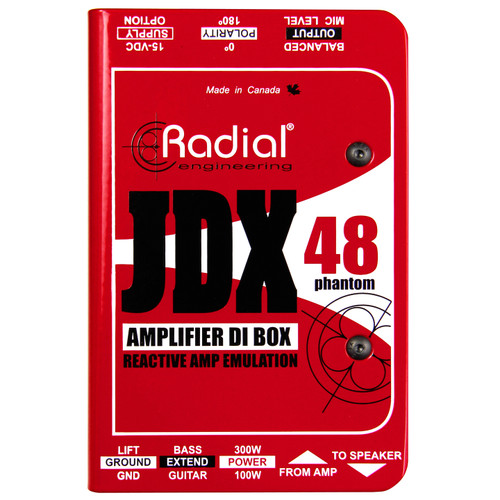
Active Direct Boxes use powered electronics to buffer the source and provide a balanced output for the recording or PA system. Their high input impedance can make them especially useful for passive electric bass, acoustic instruments with pickups and other sources where maintaining the instrument's natural response is important. Depending on the design, an Active DI may run from phantom power, batteries or an external power supply and may also provide pads, filters, variable impedance, tone shaping or additional output options.
Passive Direct Boxes for Stage and Studio
Passive Direct Boxes typically use transformer-based circuitry and require no batteries or phantom power. Their straightforward design makes them popular for keyboards, synthesizers, drum machines, active basses, playback systems and other sources with enough output level to drive the transformer effectively. Transformer isolation can also help break ground loops and reduce hum between connected pieces of equipment, making a quality Passive DI a useful problem-solving tool in both studio and live sound environments.
Direct Boxes for Bass Guitar
Bass is one of the classic applications for a DI Box because a direct signal provides a solid, repeatable foundation that can be used on its own or blended with a miked amplifier. An Active DI can provide a high-impedance input for passive bass pickups, while Passive DIs are often a natural fit with active basses and other higher-output sources. Engineers can record the DI alongside an amplifier microphone and decide later how much of each signal belongs in the mix, giving bass tracks both low-frequency definition and the character of the amp.
Direct Boxes for Acoustic Guitar and Keyboards
DI Boxes are equally useful for acoustic instruments with pickups, keyboards, synthesizers, drum machines and stereo playback rigs. Acoustic guitar pickups can benefit from an appropriately matched high-impedance input, while keyboards and electronic instruments often need reliable balanced outputs for long cable runs to a console or recording system. Stereo instruments may require a dual-channel DI so both sides of the signal remain separate, and pads or additional input options can be valuable when working with hotter line-level sources.
500-Series Direct Boxes
500-Series Direct Boxes bring DI and instrument interfacing into a modular studio rack. These modules can sit alongside 500-Series Preamps, Equalizers, Compressors and other processors, allowing engineers to keep instrument recording and re-amping tools integrated with the rest of the analog front end. The format can be especially useful in commercial studios where several signal-chain options need to stay wired and ready without adding another standalone box to the control room.
Re-Amplifying Guitar and Bass Tracks
Re-Amplifying reverses part of the traditional DI workflow by taking a previously recorded signal from the studio and converting it to a level and impedance suitable for feeding guitar amplifiers, pedals and other instrument-level equipment. Recording a clean DI alongside the original amplifier gives engineers the freedom to revisit amp choice, microphone placement, pedals and tone later in the production process. Re-amping is especially useful when the performance is right but the final guitar or bass sound still needs to be developed during mixing.
Recording a DI and Microphone Together
A common studio workflow is to capture both a direct signal and a miked amplifier at the same time. The DI provides a clean reference with strong transient definition, while the microphone captures the tone of the amplifier, speaker and room. For guitar or bass sessions, pairing a Direct Box with the right Dynamic Microphone or Ribbon Microphone gives engineers two complementary signals that can be blended during mixing or used independently depending on the production.
Ground Lift, Pads and Transformer Isolation
Many Direct Boxes include practical tools that help solve real-world signal problems. A ground-lift switch can help interrupt certain ground-loop paths that cause hum, while an input pad allows higher-level sources to be connected without overloading the DI circuit. Transformer-equipped designs can provide galvanic isolation between connected systems, which can be particularly valuable on stage or in larger studios where several pieces of equipment are powered from different parts of the electrical system. These features can be just as important as tonal character when selecting a DI for professional use.
Build a Complete Instrument Recording Chain
A Direct Box can be the starting point for a flexible guitar, bass or keyboard recording chain. Send the balanced DI output into a Microphone Preamp or recording console, capture the signal through an Audio Interface, and record a separate amplifier microphone when additional tone and ambience are desired. If the performance needs a different amp sound later, a Re-Amplifying system can send the clean recorded track back through amplifiers and pedals. Direct Box Accessories are also available for rack mounting, installation and compatible system expansion.

 Sign Up for exclusive sales and offers!