Gates & Expanders

Gates & Expanders at Front End Audio

Gates & Expanders give recording and live sound engineers control over unwanted bleed, noise and low-level material while preserving the dynamics of the source. Front End Audio carries 500-Series Gates & Expanders, Dual Channel Gates & Expanders and Multi-Channel Gates & Expanders for studio tracking, mixing, drums, broadcast and live production. From tightening close-miked drums to reducing spill between microphones or controlling background noise between phrases, these processors give engineers another way to shape the behavior of a signal without relying entirely on compression.

Choosing a Gate or Expander

The right Gate or Expander depends on how aggressively you need to control low-level material and how naturally the processor should respond. A Noise Gate can reduce or mute a signal once it falls below a set threshold, while an Expander reduces level more gradually and can provide smoother control when a hard on-off response would sound unnatural. Threshold, attack, hold, release, range and sidechain filtering are among the most important controls because they determine when the processor opens, how quickly it reacts and how naturally it returns to attenuation.

Noise Gates for Drum Recording

Drums are one of the most common applications for Noise Gates because close microphones often capture substantial spill from the rest of the kit. A gate can help tighten kick, snare and tom tracks by reducing cymbal wash and other unwanted sound between hits while preserving the impact of the drum itself. Pairing Gates & Expanders with Drum Microphone Packages or individual Dynamic Microphones gives engineers more control over isolation and envelope once the signals enter the analog processing chain.

Expanders for More Natural Dynamic Control

Expanders provide a more gradual alternative to traditional gating by lowering quieter material rather than completely muting it. This can be useful on vocals, acoustic instruments, room microphones and other sources where natural ambience needs to remain intact but background noise or bleed should be reduced. Expansion can also increase the contrast between louder and quieter parts of a performance, making it a useful tool for shaping dynamics without the obvious cutoff that can occur with aggressive gate settings.

500-Series Gates & Expanders

500-Series Gates & Expanders bring noise control and envelope shaping into a compact modular rack. These modules can sit alongside 500-Series Preamps, Equalizers and Compressors to create complete analog recording or mixing chains inside the same chassis. The format is especially useful for studios that want dedicated gate processing on a small number of important channels without dedicating a full rack space to every processor.

Dual Channel Gates & Expanders

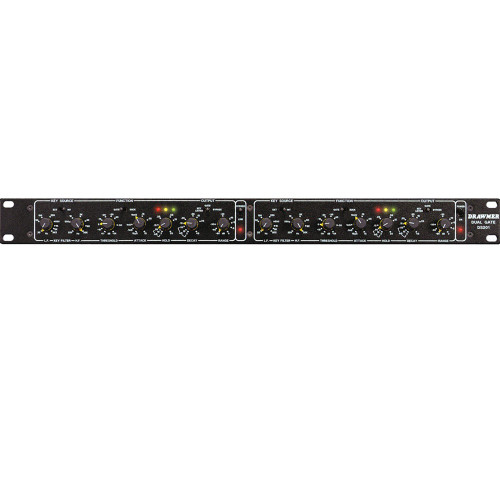
Dual Channel Gates & Expanders provide two channels of dynamics control within one processor, making them useful for stereo sources or two independent mono channels. In drum recording, a dual-channel unit can handle two toms, kick and snare or other paired sources, while live sound engineers can use the same hardware across multiple microphones or instrument channels. Depending on the design, channels may operate independently or provide linking options when coordinated processing is required.

Multi-Channel Gates & Expanders

Multi-Channel Gates & Expanders are designed for sessions and live systems where several sources need dynamics control at the same time. Multi-channel processing is particularly useful across drum kits, larger microphone setups and installations where using an individual processor for every channel would consume too much rack space. Consistent controls across several channels can also make setup faster when similar gate behavior is required across related sources.

Sidechain Filtering and More Accurate Triggering

Sidechain filtering can make a Gate or Expander respond more accurately by limiting which frequencies influence the detector circuit. On a drum kit, for example, the sidechain can help a gate respond more strongly to the fundamental range of a kick or snare while ignoring some of the cymbal spill around it. This can reduce false triggering and make the processor behave more naturally in a dense mix. The available sidechain controls vary by model, so engineers working with difficult or heavily bleeding sources should pay particular attention to the detector and filtering options.

Gates, Expanders and Compression

Gates and Expanders control the quieter side of a signal's dynamic range, while Compressors & Limiters are generally used to control louder peaks and reduce overall dynamic range. Using both types of processing together can provide more complete control over a source: a gate may reduce unwanted spill or noise between notes while a compressor shapes the louder performance itself. The order and amount of processing should be chosen around the source so the final result remains musical rather than overly controlled.

Gates & Expanders for Studio and Live Sound

Although Gates & Expanders are closely associated with drum recording, they are equally useful in live sound, broadcast and other environments where several open microphones can increase background noise and bleed. Properly adjusted dynamics processing can reduce unwanted signal between performances while allowing the desired source to pass naturally once it exceeds the threshold. For studio recording, these same tools can help create cleaner individual tracks before mixing, while live engineers can use them to maintain better separation across complex microphone setups.