



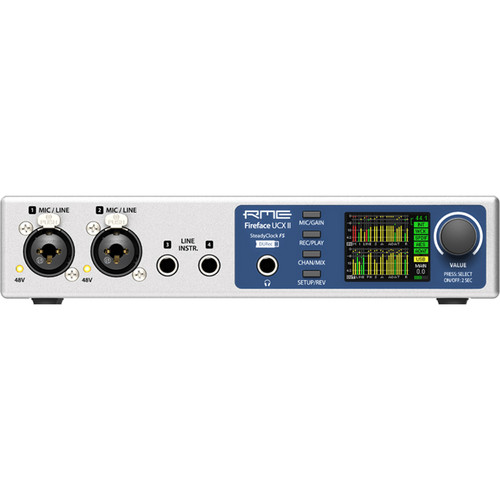
The RME Fireface UFX II Audio Interface brings serious studio horsepower to recording, mixing, monitoring, and live production with 60 channels of audio, premium conversion, four high-gain microphone preamps, extensive digital connectivity, and RME's renowned low-latency performance.
Designed for professional studios and demanding project rooms alike, the Fireface UFX II combines flexible analog and digital I/O with TotalMix FX, SteadyClock FS, direct USB recording, and class-compliant operation, making it an exceptionally capable centerpiece for complex audio systems. Built around 30 input and 30 output channels, the RME Fireface UFX II offers 12 channels of analog I/O alongside dual ADAT, AES/EBU, word clock, and MIDI connectivity. Four front-panel microphone, instrument, and line inputs provide up to 75 dB of gain with a PAD-free preamp design capable of handling input levels up to +18 dBu. Its premium AD/DA conversion and optimized analog circuitry deliver the transparent, highly detailed sound expected from an RME professional USB audio interface, while two powerful low-impedance headphone outputs make independent monitoring straightforward. TotalMix FX gives engineers extensive control over routing, submixes, cue mixes, monitoring, and DSP processing without relying on the computer's native mixer. EQ, dynamics, reverb, and delay can be applied directly within the hardware mixing environment, while Room EQ expands monitoring control with additional parametric equalization, volume calibration, and crossfeed functionality. SteadyClock FS provides low-jitter synchronization, and the Fireface UFX II's DC-coupled line outputs can even send CV and gate signals to compatible modular synthesizers. For recording without a computer, RME's DURec technology allows selected input and output channels to be recorded directly to USB storage devices connected to the front-panel USB port. This gives the Fireface UFX II useful standalone capabilities for live recording, rehearsals, virtual soundchecks, and mobile applications while retaining the routing and processing flexibility of its internal DSP.
RME Fireface UFX II Audio Interface Features
- 60-channel professional USB audio interface with 30 inputs and 30 outputs
- Supports sample rates up to 192 kHz
- 12 channels of analog input and output
- Four front-panel microphone, instrument, and line inputs
- Microphone preamps provide up to 75 dB of gain
- Premium AD/DA converters and optimized analog circuitry
- Dual ADAT optical I/O for multichannel digital expansion
- AES/EBU digital input and output
- Word clock input and output for external synchronization
- Two MIDI inputs and outputs
- Two high-power, low-impedance headphone outputs
- TotalMix FX hardware mixing and routing
- Integrated EQ, dynamics, reverb, and delay processing
- Room EQ functionality within TotalMix FX
- SteadyClock FS for highly stable low-jitter digital synchronization
- DURec direct USB recording for standalone multichannel recording and playback
- DC-coupled line outputs support CV and gate control for compatible modular synthesizers
- Class Compliant Mode for compatible computer and iPad operation
- Compatible with the optional RME ARC USB remote controller
- Standalone operation supported
- RME USB 2.0 connectivity
RME Fireface UFX II Audio Interface Specifications
- Analog:
- AD, Line In 1-8, Rear:
- Resolution AD: 24 bit
- Signal to Noise ratio (SNR): 113 dB RMS unweighted, 116 dBA
- Frequency Response @ 44.1 kHz, -0.1 dB: 5 Hz 20.8 kHz
- Frequency Response @ 96 kHz, -0.5 dB: 3 Hz 45.8 kHz
- Frequency Response @ 192 kHz, -1 dB: 2 Hz 92 kHz
- THD: < -110 dB, < 0.00032 %
- THD+N: < -104 dB, < 0.00063 %
- Channel Separation: > 110 dB
- Maximum Input Level: +19 dBu
- Input: 6.3 mm TRS jack, electronically balanced
- Input Impedance: 8 kOhm unbalanced, 12 kOhm balanced
- Input Sensitivity Switchable to Lo Gain: +4 dBu
- Input Level for 0 dBFS @ Lo Gain: +19 dBu
- Input Level for 0 dBFS @ +4 dBu: +13 dBu
- Variable Gain: 0 to +12 dB
- Minimum Level for 0 dBFS: +1 dBu, -1.2 dBV
- Microphone In 9-12, Front:
- Input: XLR, electronically balanced
- Input Impedance: 3.4 kOhm
- Signal to Noise Ratio (SNR): 115 dB RMS unweighted, 118 dBA
- Gain Range: 75 dB
- Maximum Input Level, Gain 0 dB: +18 dBu
- Maximum Input Level, Gain 75 dB: -57 dBu
- CLIP LED: 0 dBFS SIG LED: -60 dBFS
- Instrument In 9-12, Front:
- Input: 6.3 mm TS jack, unbalanced
- Input Impedance: 1 MOhm
- Signal to Noise Ratio (SNR): 114 dB RMS unweighted, 118 dBA
- Gain Range: 42 dB
- Maximum Input Level, Gain 8 dB: +21 dBu
- Maximum Input Level, Gain 50 dB: -21 dBu
- DA, Line Out 3-8, Rear:
- Resolution: 24 bit
- Dynamic Range (DR): 115 dB RMS unweighted, 118 dBA
- Frequency Response @ 44.1 kHz, -0.5 dB: 5 Hz 20.8 kHz
- Frequency Response @ 96 kHz, -0.5 dB: 5 Hz 45 kHz
- Frequency Response @ 192 kHz, -1 dB: 5 Hz - 89 kHz
- THD: < -110 dB, < 0.00032 %
- THD+N: < -104 dB, < 0.00063 %
- Channel Separation: > 110 dB
- Maximum Output Level: +19 dBu
- Output: 6.3 mm TRS jack, servo-balanced
- Output Impedance: 75 Ohm unbalanced, 150 Ohm balanced
- Output Level Switchable Hi Gain: +4 dBu, -10 dBV
- Output Level at 0 dBFS @ Hi Gain: +19 dBu
- Output Level at 0 dBFS @ +4 dBu: +13 dBu
- Output Level at 0 dBFS @ -10 dBV: +2 dBV
- DA - Stereo Monitor Output XLR (1-2):
- Output: XLR, Balanced
- Output Level Switchable 24 dBu, Hi Gain: +4 dBu, -10 dBV
- Output Level at 0 dBFS @ 24 dBu: +24 dBu
- Output Level at 0 dBFS @ Hi Gain: +19 dBu
- Output Level at 0 dBFS @ +4 dBu: +13 dBu
- Output Level at 0 dBFS @ -10 dBV: +2 dBV
- DA - Stereo Monitor Output Phones (9-12):
- Output: 2 x 6.3 mm TRS stereo jack, unbalanced
- Maximum Output Level at 0 dBFS, High: +19 dBu
- Maximum Output Level at 0 dBFS, Low: +2 dBV
- Output Impedance: 2 Ohm
- Max Power Per Channel @ 32 Ohm load, 0.1% THD: 210 mW (2.6 Vrms, +10.5 dBu)
- AD, Line In 1-8, Rear:
- MIDI:
- MIDI I/O: 2 x MIDI I/O via 5-pin DIN jacks
- Isolation: Galvanically isolated by optocoupled input
- Hi-speed Mode: Jitter and response time typically below 1 ms
- FIFO I/O: Separate 128 byte FIFOs for input and output
- Digital:
- Clocks: Internal, ADAT, AES, MADI, word clock
- Low Jitter Design: < 1 ns in PLL mode, all inputs
- Internal Clock: 800 ps Jitter, Random Spread Spectrum
- Jitter Suppression of External Clocks: > 30 dB (2.4 kHz)
- Effective Clock Jitter Influence on AD and DA Conversion: Near zero
- PLL: Ensures zero dropout, even at more than 100 ns jitter
- Digital Bitclock PLL: For trouble-free varispeed ADAT operation
- Supported Sample Rates: 28 kHz up to 200 kHz
- Digital Inputs:
- AES/EBU:
- XLR: 1 x XLR, transformer-balanced, galvanically isolated, according to AES3-1992
- High-sensitivity Input Stage: (< 0.3 Vpp) SPDIF compatible (IEC 60958)
- Format: Accepts Consumer and Professional format
- Lock Range: 27 kHz 200 kHz
- Jitter When Synced to Input Signal: < 1 ns
- Jitter Suppression: > 30 dB (2.4 kHz)
- ADAT Optical:
- TOSLINK: 2 x TOSLINK, format according to Alesis specification
- Standard: 2 x 8 channels 24 bit, up to 48 kHz
- Double Speed (S/MUX): 2 x 4 channels 24 bit 96 kHz
- Quad Speed (S/MUX4): 2 x 2 channels 24 bit 192 kHz
- Bitclock PLL: Ensures perfect synchronisation even in varispeed operation
- Lock Range: 31.5 kHz 50 kHz, Jitter when synced to input signal: < 1
- SPDIF Optical (ADAT2):
- Optical: 1 x Optical, according to IEC 60958
- Format: Accepts Consumer and Professional format
- Lock Range: 27 kHz 200 kHz
- Jitter When Synced to Input Signal: < 1 ns
- Jitter Suppression: > 30 dB (2.4 kHz)
- Word Clock:
- BNC:
- Internal Termination: 75 Ohm switchable
- Speed Detection: Automatic Double/Quad Speed detection and internal conversion to single speed
- SteadyClock: Guarantees super low jitter synchronization even in varispeed operation
- DC-offsets: Not affected by DC-offsets within the network
- Signal Adaptation Circuit: Signal refresh through auto-center and hysteresis
- Overvoltage Protection:
- Level Range: 1.0 Vpp 5.6 Vpp
- Lock Range: 27 kHz 200 kHz
- Jitter When Synced to Input Signal: < 1 ns
- Jitter Suppression: > 30 dB (2.4 kHz)
- AES/EBU:
- Digital Outputs:
- AES/EBU:
- XLR: Transformer-balanced, galvanically isolated, according to AES3-1992
- Output Level Professional: 4.5 Vpp, Consumer 2.6 Vpp
- Format Professional: According to AES3-1992 Amendment 4
- Format Consumer (SPDIF): According to IEC 60958
- Single Wire Mode: Sample rate 28 kHz up to 200 kHz
- ADAT:
- TOSLINK: 2 x TOSLINK
- Standard Channels: 2 x 8 channels 24 bit, up to 48 kHz
- Double Speed (S/MUX): 2 x 4 channels 24 bit 96 kHz
- Quad Speed (S/MUX4): 2 x 2 channels 24 bit 192 kHz
- SPDIF Optical (ADAT2):
- Format Consumer (SPDIF): according to IEC 60958
- Sample Rate: 28 kHz up to 200 kHz
- Word Clock:
- BNC:
- Max. Output Voltage: 5 Vpp
- Output Voltage @ 75 Ohm Termination: 4.0 Vpp
- Output Impedance: 10 Ohm
- Frequency Range: 27 kHz 200 kHz
- AES/EBU:
- General:
- Power Supply: Internal switching PSU, 100 - 240 V AC, 36 Watts
- Idle Power Consumption: 19 Watts
- Typical Power Consumption: 22-25 Watts
- Dimensions Including Rack Ears (W x H x D): 483 x 44 x 210 mm (19" x 1.73" x 8.5")
- Dimensions Without Rack Ears (W x H x D): 440 x 44 x 210 mm (17.3" x 1.73" x 8.3")
- Total Depth: 240 mm (9.4)
- Weight: 3 kg ( 6.6 lbs)
- Temperature Range: +5° up to +50° Celsius (41° F up to 122°F)
- Relative Humidity: < 75%, non condensing
RME Fireface UFX II Audio Interface Includes
- RME Fireface UFX II Audio Interface
- USB 2.0 Cable, 1.8 m (6 ft)
- Power Cord
- User Manual
- Manufacturer Warranty
2 Reviews Hide Reviews Show Reviews
-
Very best all-in-one interface
Jan 16th 2020I upgraded from Babyface Pro to UFX2 and felt it had a noticeable improvement in terms of converters and the mic preamp. This maschine is being used to hook up to my keyboard instruments, mixer, external converters, etc., and I like it is really versatile and stable in complex setup surroundings.
-
Standard in the Field
Mar 2nd 2015Have 5 products by RME and always select this company for 2 reasons -- their stuff works and the quality is always comparable to the best in the field. Have a UCX as well and find the UFX to be substantially more useful in a small home studio. Haven't tried the standalone USB stick recording feature yet but if this works, it will be a great help in single-person recording situations. Their equipment lasts -- have an ADI96-Pro from 2000 and it still works through SPDIF connection. BTW, suggest you get a converter that speaks through USB -- it is much more likely to last as computers evolve.
Write a Review





 Sign Up for exclusive sales and offers!