



The Studio Technologies Model 780/790 Surround Monitoring System combines Model 780-01 Central Controller and Model 790 Control Console for simple and effective monitoring of 8-channel surround (7.1) audio material during the recording and post-production process.
The Studio Technologies Model 780/790 Surround Monitoring System provides digital inputs and digital outputs. Creating and distributing eight channel (7.1) surround audio material has become common for entertainment, cinema, and allied applications. As such, the ability to simply and effectively monitor these sources is imperative during the recording and post-production process. Studio Technologies has addressed these needs with the StudioComm for Surround Model 780-01 Central Controller and the Model 790 and Model 71 Control Consoles. With digital audio inputs, digital monitor outputs, support for multiple user control surfaces, and an extensive set of resources it's a simple task to integrate a monitoring system into virtually any facility. The carefully selected group of features, including two surround (7.1) and one stereo input, configurable input-source time delay, LFE low-pass filter, pre- and post-fader surround outputs, configurable downmix and mute/solo functions, and bass management, along with a multi-format sync input, make the system powerful yet simple to operate. And by using the best of contemporary technology, as well as following rigorous design practices, the system's audio quality is excellent.
Model 790 Control Console
A StudioComm for Surround system starts with the Studio Technologies Model 790 Control Console. It's the system's "command center" and is designed to reside at a user's location, allowing fingertip selection of all monitoring functions. Numerous LEDs provide complete status information. A 4-digit numeric display indicates the level of the post-fader monitor output. A major strength of the Studio Technologies Model 790 is its ability to configure, under software control, many important operating parameters. Intended for secondary monitoring locations that don't require all of the Model 790's features, the Studio Technologies Model 71 Control Console is a compact user control surface. It provides three of the most basic functions: a rotary level control, dim on/off button, and reference level on/off button. Most installations will use only one Model 790 Control Console. However, up to three additional Studio Technologies Model 790 or Model 71 Control Consoles can also be connected. This provides multiple users with control over a facility's monitor system. And to make installation simple, the Studio Technologies Model 780-01 provides power for all connected Studio Technologies Model 790 or Model 71 units.
Model 780-01 Central Controller
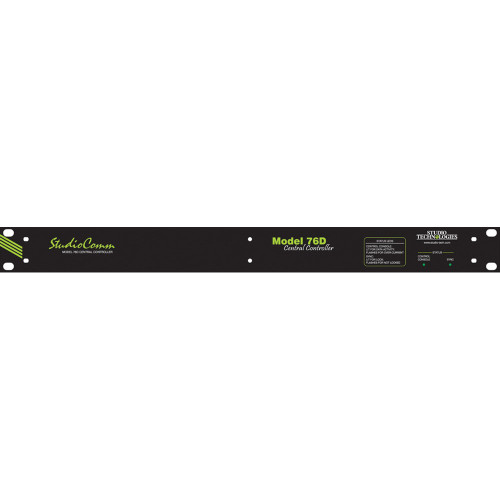
The core of this StudioComm for Surround system is the Studio Technologies Model 780-01 Central Controller. The one-rack-space unit contains circuitry that supports balanced digital audio inputs, balanced digital monitor outputs, digital audio and control processing, and interfacing for the user control surface(s). The Studio Technologies Model 780-01 provides two surround (7.1) and one stereo digital audio inputs. These balanced digital inputs are AES3-compliant; sources of this type are ubiquitous in many post-production and audio facility environments. The inputs allow a sample rate of 44.1, 48, 88.2 or 96 kHz and a bit depth of up to 24 to be supported. Circuitry associated with the stereo input provides sample rate conversion (SRC) capability, allowing a wide range of digital audio sources to be monitored. To compensate with processing delays (latency) associated with associated video displays up to 340 milliseconds of input delay can be selected. For flexibility, two delay values can be configured, allowing real-time selection as desired. A number of different signals can serve as the Studio Technologies Model 780-01's digital audio timing reference. For synchronization with a master timing reference a dedicated source of word clock, DARS (AES11), bi-level video, or tri-level video can be connected. Alternately, the L/R connection of the actively selected surround or stereo input source can serve as the timing reference.
Studio Technologies Model 780/790 Surround Monitoring System Features
- 7.1 surround and stereo balanced digital audio inputs
- 7.1 surround balanced digital outputs
- Balanced digital audio capability
- Allows use of multiple control consoles
- Superior audio quality
Studio Technologies Model 780/790 Surround Monitoring System Specifications
- Model 780-01 Central Controller:
- General Audio:
- Supported Sample Rates: 44.1, 48, 88.2, and 96 kHz
- Word Length: 24 bits Maximum
- Internal Processing: 32 bits
- Input-to-Output Latency: Two Samples (e.g., 0.042 milliseconds @ 48 kHz Sample Rate)
- Digital Audio Inputs: 5 (18 Audio Channels Total)
- Configuration: Two Surround (7.1) and One Stereo
- Type: Balanced AES3 (110 Ohms, 5 Vpp)
- Connector—Surround Inputs: 25-Pin Female D-Subminiature (DB-25F), AES59-2012 Compliant
- Connector—Stereo Input: 3-Pin Female XLR
- Sample Rate Conversion (SRC):
- Application: Available on the Stereo Input
- Input Sample Rate Range: 8 to 216 kHz, Limited to 1/6 to 6 Times the Output Sample Rate
- Latency: 1 millisecond, Nominal
- LFE Input Channel Low-Pass Filter: –6 dB @ 120 Hz, 48 dB-Per-Octave, On/Off Selectable
- Sync Source: Configured to Follow L/R of Currently Selected Input or Signal Connected to Sync Input
- Sync Input:
- Compatible Sources: Word Clock, DARS (AES11), Bi-Level Video, Tri-Level Video
- Jitter: 4 ns pp Maximum
- Connector: BNC (Per IEC 60169-8 Amendment 2)
- Termination: 75 Ohms, Selectable On/Off
- Digital Monitor Outputs: 2 (16 Channels Total)
- Configuration: Organized As Two Surround (7.1), One Pre-Fader, and One Post-Fader
- Dynamic Range: >135 dB
- Type: Balanced AES3 (110 Ohms, 5 Vpp)
- Connector: 25-Pin Female D-Subminiature (DB-25F), AES59-2012-Compliant
- Configurable Input Delay: 0 to 340 milliseconds @ 48 kHz Sample Rate (Scales Up Or Down Depending on Actual Sample Rate)
- Post-Fader Monitor Output Level Offsets: Each Channel Independently Adjustable in 0.5-dB Steps Over a ±12-dB Range
- Bass Management:
- Crossover Frequency and Type: –6 dB @ 40, 50, 60, or 80 Hz, Symmetrical for Low-Pass and High-Pass Filters, Maximally Flat
- Filter Slope: 12 dB-Per-Octave or 24 dB-Per-Octave
- Overall Operation: On/Off Selectable
- Downmix: To 5.1, To Stereo, and To Mono
- Control Console Interface:
- Type: RS-485, 115.2 k bit/s, 8-1-N
- Polling Interval: 80 milliseconds, Nominal
- Power: 12 VDC, 500 mA Maximum
- Connector: 9-Pin Female D-Subminiature (DE-9F)
- Remote Control Inputs: 2
- Functions: Remote Mute All, Remote Dim
- Type: 3.3 VDC Logic, Activates on Closure to System Common
- Connector: 9-Pin Female D-Subminiature (DE-9F)
- AC Mains:
- Requirement: 100 to 240 V, +10/–15%, 50/60 Hz, 15 W Maximum
- Connector: 3-Blade, IEC 320 C14-Compatible (Mates with IEC 320 C13)
- Dimensions:
- Width: 19.00 inches (48.3 cm)
- Height: 1.72 inches (4.4 cm)
- Depth: 7.00 inches (17.8 cm)
- Mounting: One Space (1U) in A Standard 19-inch Rack
- Weight: 3.6 Pounds (1.6 kg)
- General Audio:
- Model 790 Control Console:
- Application: Up to Four Model 790 Control Consoles Can be Connected to A Model 780-01 Central Controller
- Power: 12 VDC Nominal (9 VDC Minimum), Maximum Current 100 mA, Provided by Model 780-01 Central Controller
- Control Data:
- Type: RS-485
- Data Rate/Format: 115.2 k bit/s, 8-N-1
- Connector: 9-Pin Female D-Subminiature (DE-9F)
- Dimensions (Overall):
- Width: 7.20 inches (18.3 cm)
- Height: 2.20 inches (5.6 cm)
- Depth: 5.40 inches (13.7 cm)
- Weight: 1.7 pounds (0.8 kg)
Studio Technologies Model 780/790 Surround Monitoring System Includes
- 1 x Studio Technologies Model 780-01 Central Controller
- 1 x Studio Technologies Model 790 Control Console
- 1 x Power Cord
- 1 x User Guide
- 3 Year Warranty
No review yet, Be first to Write a Review
Write a Review




 Sign Up for exclusive sales and offers!