



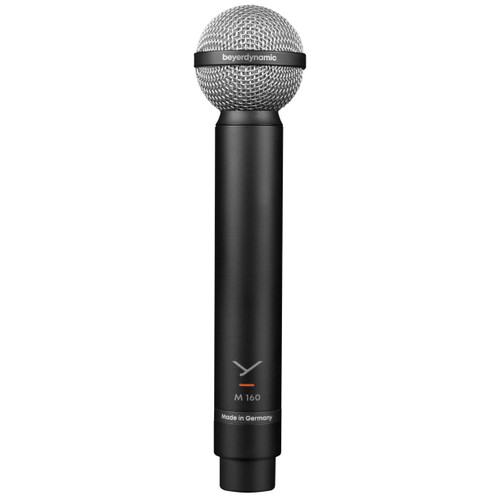
The Beyerdynamic M 160 Ribbon Microphone is one of the indisputable legendary ribbon microphones of the classic rock era. The M 160 Ribbon Microphone is perfect for miking string instruments and guitar amps.
The multi-award-winning M 160 dynamic double-ribbon microphone is exceptional in its sound and manufacturing: intricate handmade craftsmanship meets unique technical features. Affectionately known as a “gem”, the M 160 has enriched hit after hit with a sound character that has very little tonal colouring. A precise bass response, warm mids and silkily elegant trebles merge together to form a very unique sound. Those who are familiar with this microphone will know: there is no alternative to the M 160.
Softens harsh sounds
The M 160 is ideal for miking electric guitar amps. This is due not only to its hypercardioid polar pattern, which is unique among ribbon microphones, but also to its special sound character. The M 160 delivers a warm but nevertheless natural sound. In addition, the M 160 easily masters the high sound pressures of a guitar amp and provides a signal that is perfect for processing.
Ideal for Drums
Whether as overhead, for the hi-hat or as a room microphone, the M 160 is an excellent choice for miking a drumkit. In particular, sharp sounds such as cymbals are reproduced in a well-balanced way. In addition, the low mass of the two wafer-thin double-ribbons ensures high impulse fidelity. Sounds with a strong attack are precisely reproduced thanks to the microphone’s quick transient response.
A double-ribbon microphone for every application
The M 160 is an exceptionally versatile member of the ribbon microphone family. Its high-definition sound and wide frequency response of 40–18,000 Hz take effect when miking not only drums and amps, but also acoustic guitars, brass instruments and strings. In combination with a wind shield, the M 160 is a great choice for those who wish to give their voice a warm, vintage sound. Together with the dynamic double-ribbon M 130, which has a figure-eight polar pattern, the M 160 can also be used for M/S recording.
A very special pattern
The M 160 is the only doubl-ribbon microphone with a hypercardioid polar pattern on the market. This polar pattern prioritises sound coming from the front, while most of the signals from the sides and some from the back are reduced. Rear attenuation is 25 dB at 110° and 250°. This ensures excellent channel separation. Thanks to this technical refinement, the warm sound of a ribbon can be used in completely new situations.
Quality Made in Germany
The M 160 is the embodiment of top-quality craftsmanship. From the exact width of two hand-stamped pure aluminium ribbons, to placing them in the magnet gap with millimetre precision, through to testing the vibration behaviour. Manufacturing various components in-house, such as the microphone grille or the transformer, gives us permanent control over compliance with our high quality standards. This is reflected in our choice of specialists. The production of an M 160 requires particular dexterity. In the end, all of this hard work becomes apparent in the microphone’s outstanding sound quality. Every microphone is a masterpiece thanks to exacting precision “Made in Germany”.
Beyerdynamic M 160 Ribbon Microphone Features
- Unique double ribbon-microphone
- Ideal for use with guitar amps and drums
- Double-ribbon with hypercardioid polar pattern
Extraordinary sound character - Handmade in Germany
Beyerdynamic M 160 Ribbon Microphone Specifications
- Transducer Type: Dynamic
- Operating Principle: Pressure Gradient
- Frequency Response: 40 - 18,000 Hz
- Polar Pattern: Hypercardioid
- Rear Attenuation at 1 kHz: > 25 dB at 110°
- Open Circuit Voltage at 1 kHz (0 dB = 1 V/Pa): 1.0 mV/Pa = -60 dBV
- Nominal Impedance: 200 O
- Load Impedance: = 1000 O
- Diaphragm: Pure Aluminium
- Case/Finish: Brass
- Connector: XLR, 3-Pin, Male
Beyerdynamic M 160 Ribbon Microphone Includes
- Beyerdynamic M 160 Ribbon Microphone
- Microphone Clamp
- Microphone Case
- Manufacturer Warranty
4 Reviews Hide Reviews Show Reviews
-
A great little powerhouse!
Nov 17th 2022While this mic fits its usage description well you should really try throwing it at everything. Guess what mic Billy Joel used on his first few albums. That's right, the M160. Pianists (myself included) hate to break up the singing and the playing. Enter a great sounding hypercardioid for vocals. Connect it to a clean pre with plenty of gain and it will impress you.
-
Wow...
Oct 19th 2017If you are a sax player and want a contemporary sound, this is the mic to have. Not to mention how well it works on so many other sources - guitar cabs, percussion, drum overheads, certain acoustic instruments, you name it. Seriously, I did some tracking on my tenor sax (I'm a somewhat gritty and forward player) and didn't need to compress or EQ at all, as the track just sat in the mix and sounded "professional". Running through a good pre always helps, as I run through an AEA ribbon preamp. I've used it this mic on vocals, individual snare drum, and other sources, and it just works well. I would have no problem purchasing this mic for a good mic locker, and am seriously considering getting another.
-
New favorite mic
Jul 19th 2011Solid choice for drum overheads where you need that softer ribbon character but don't want them too dark. With the right preamp, has excellent focus without being clinical. Haven't used on guitar cab myself, but very impressed with others' results for that application.
-
Satisfied customer
Feb 6th 2011Eddie Kramer knows his stuff. Solid lows, punchy mids, handles spl's a foot off a Marshall cab very nicely for a ribbon. Wonderful as an OH or room mic. Likely will get another soon.
Write a Review




 Sign Up for exclusive sales and offers!